
Public sector organisation
Land the platform in AWS without sacrificing resilience
How the public-sector case study moved onto AWS using Terraform, ECS Fargate, PostgreSQL, Redis-backed sessions, and GitHub Actions while the team validated the new runtime internally.
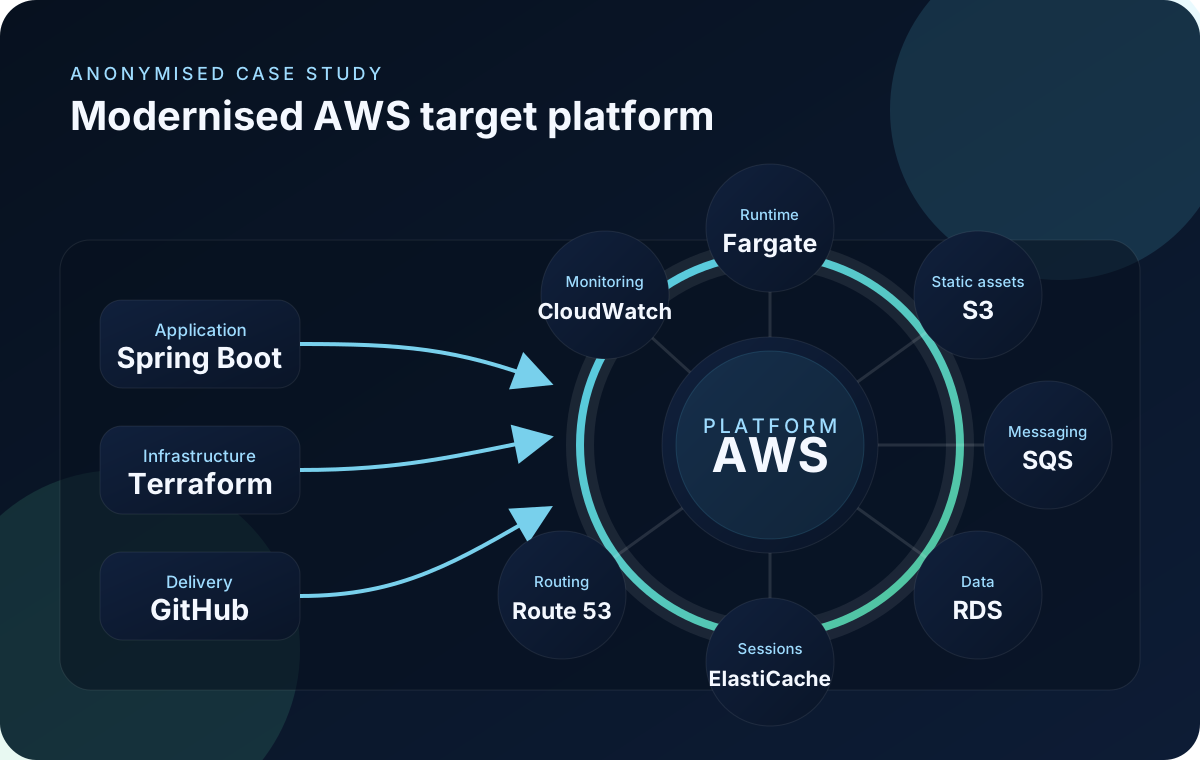
By this point the application was ready to leave the purely legacy hosting model behind. The next step was to build the runtime and operational model we actually wanted.
For Atlas Orders that meant:
- provisioning an ECS Fargate cluster
- defining infrastructure with Terraform
- replacing Oracle with PostgreSQL
- introducing GitHub Actions for build and deployment
- making session handling resilient across multiple running tasks
Provisioning the new platform
The infrastructure work was not treated as an afterthought once the application was “done”. It was part of the migration.
We used Terraform to provision the ECS Fargate cluster and the surrounding AWS estate. That gave the team a repeatable, reviewable definition of the target platform instead of a set of manually built environments that would inevitably drift.
The new runtime model immediately improved a few things:
- services could be scaled horizontally without managing more application server VMs
- container images became the deployable unit rather than hand-built server state
- infrastructure changes became visible in pull requests
- the path to safer repeatable environments became much clearer
At this stage the architecture was recognisably different from the original estate:
- GitHub and GitHub Actions replaced the opaque release path
- container images became the deployable contract
- ECS Fargate replaced long-lived WebLogic VMs
- Route53 and load balancing gave us more controlled traffic management
- Redis removed the need for fragile sticky-session assumptions
- Terraform gave the estate a maintainable infrastructure definition
Taking the database opportunity at the right moment
The database decision was specific to this application.
Atlas Orders was not tightly coupled to Oracle in the way some legacy estates are. That gave us a good opportunity to move to PostgreSQL as part of the platform landing. On another programme, that might have been the wrong time to make a database change. Here it was a pragmatic choice because the application’s persistence layer was not so Oracle-specific that it would dominate the migration risk.
The benefit was not just licensing or preference.
Moving to PostgreSQL let the team align the platform more closely with the target AWS operating model, reduce some of the specialist overhead of the previous estate, and simplify the long-term hosting story.
That was also a cost decision. Reducing dependence on Oracle-era infrastructure and specialist administration lowered the ongoing operational burden around the application.
Introducing GitHub Actions at the point it could add real value
Earlier in the migration we had deliberately not rushed the deployment pipeline.
Now it made sense.
Once the codebase was in GitHub, the build was under Gradle, the runtime shape was clearer, and the container target existed, GitHub Actions became the natural place to automate build and deployment.
That gave the programme:
- consistent container builds
- traceable deployments from source control
- less dependence on locked-down jump hosts and manual release choreography
- a platform for automated checks such as vulnerability alerts and dependency updates
This is where the delivery model finally started to feel modern as well as the code.
For the client, this translated into something highly visible: releases no longer depended on a tightly controlled machine and institutional memory. They became easier to understand, audit, and improve.
Handling sessions properly in a distributed runtime
When you move from a single long-lived application server pattern into multiple container tasks, session behaviour becomes a real operational concern very quickly.
We could not afford a model where every deployment or task restart risked dropping active user sessions across the customer and order flows. Sticky sessions would have been a weak workaround, not a good target architecture.
So we introduced Redis-backed session management.
That gave the platform:
- continuity across multiple nodes
- less reliance on routing tricks
- safer rolling deployments
- more freedom to scale task counts up and down in response to demand
This was one of the more important architecture gains in the migration. It was not flashy, but it translated directly into user stability.
Why the AWS move reduced cost as well as risk
The cost story was not simply “cloud is cheaper”.
The savings came from reducing the cost of maintaining the legacy operating model:
- fewer bespoke VMs to patch and manage
- less operational ceremony around deployments
- no need to keep growing a WebLogic-centric estate just to serve the same workload
- better alignment between actual demand and running capacity
- a more supportable platform for current engineers
On top of that, uptime improved because the AWS model gave us better primitives:
- Fargate tasks could be replaced automatically
- services could run across multiple instances rather than relying on a single app server footprint
- infrastructure could be expressed and reproduced instead of repaired manually
Commercial gains
Lower infrastructure overhead, fewer specialist runtime constraints, and a delivery model that no longer depended on fragile operational ceremony.
Technical gains
Infrastructure as code, containerised delivery, shared sessions, scalable runtime behaviour, and a platform that could be operated with clearer guardrails.
At this stage the application was live internally, not yet the public source of truth.
That internal live period mattered. It gave the team the space to test performance, observe behaviour under real load, and deal with the inevitable operational issues before asking end users to depend on the new platform.
The final step was the cutover.